
A challenger brand is a business built to question the status quo.
It isn’t driven by size or market share, but by a belief that there’s a better way to do things. Challenger brands don’t just compete with market leaders, they challenge the assumptions the category is built on, whether that’s through new experiences, stronger values, or smarter solutions.
The phrase challenger brand gets used a lot. Too often, it’s treated as a label rather than a way of thinking. Something that can be applied once the logo is finished and the website is live.
In reality, challenger brands aren’t defined by how they present themselves. They’re defined by how they think, how they behave, and how willing they are to question what already exists.
At its core, being a challenger brand is about evolution. It’s about refusing to accept the status quo as the final answer and instead looking for better, smarter, more responsible ways of doing things. Sometimes that means reaching the same outcome in a more considered way. Other times it means redefining what the outcome should be in the first place.
That way of thinking doesn’t just benefit one brand. Over time, it pushes entire industries forward.
Challenger brands rarely operate in isolation. Their impact isn’t limited to their own success or failure.
When a smaller brand starts questioning accepted norms, particularly when that challenge is rooted in genuine belief rather than marketing spin, it creates pressure. It forces established players to reassess how they operate and why they do things the way they do.
This is where challenger brands become catalysts. You see it clearly in areas like sustainability, where smaller brands rethink materials, packaging, supply chains, or delivery models. At first, those decisions feel niche. Then they become expected. Eventually, the biggest brands in the world adopt similar approaches because the market demands it.
That’s when challenger thinking stops being commercial and starts becoming cultural. Not because a brand shouted the loudest, but because it proved that a better way was possible.
The challenge is that being a “challenger brand” has become fashionable. Everyone wants the credibility that comes with pushing for better. Far fewer are willing to do the harder work of changing how their business actually operates.
What often follows is performance rather than substance. Trend-led language. Surface-level gestures. The appearance of progress without the systems to support it.
It’s the same pattern seen with greenwashing. Highlighting one visible action while ignoring the rest of the operation. It might look good on the surface, but it doesn’t stand up to scrutiny.
Audiences today are more informed, more sceptical, and far quicker to question inconsistency. If a brand claims to stand for something it doesn’t genuinely live by, the result isn’t indifference, it’s distrust. And once trust is lost, it’s difficult to recover.
Genuine challenger brands don’t announce themselves. They show who they are through consistent behaviour over time.
Challenger brands and disruptor brands are often grouped together, but they’re fundamentally different.
Disruptors tend to enter an industry and force structural change. They reset expectations so dramatically that everyone else has to adapt around them. Their impact is immediate and often industry-wide.
Challenger brands work differently. They question habits, standards, and assumptions. They raise expectations gradually rather than overturning the entire system overnight. Often they’re values-led, more human in their approach, and more considered in how they grow.
This distinction matters because language sets expectation. If a brand positions itself as something it clearly isn’t, credibility erodes quickly. Brand strategy exists, in part, to prevent that mismatch. It ensures that what a brand says aligns with how it can realistically behave.
Honest positioning isn’t about playing small. It’s about building something that can last.
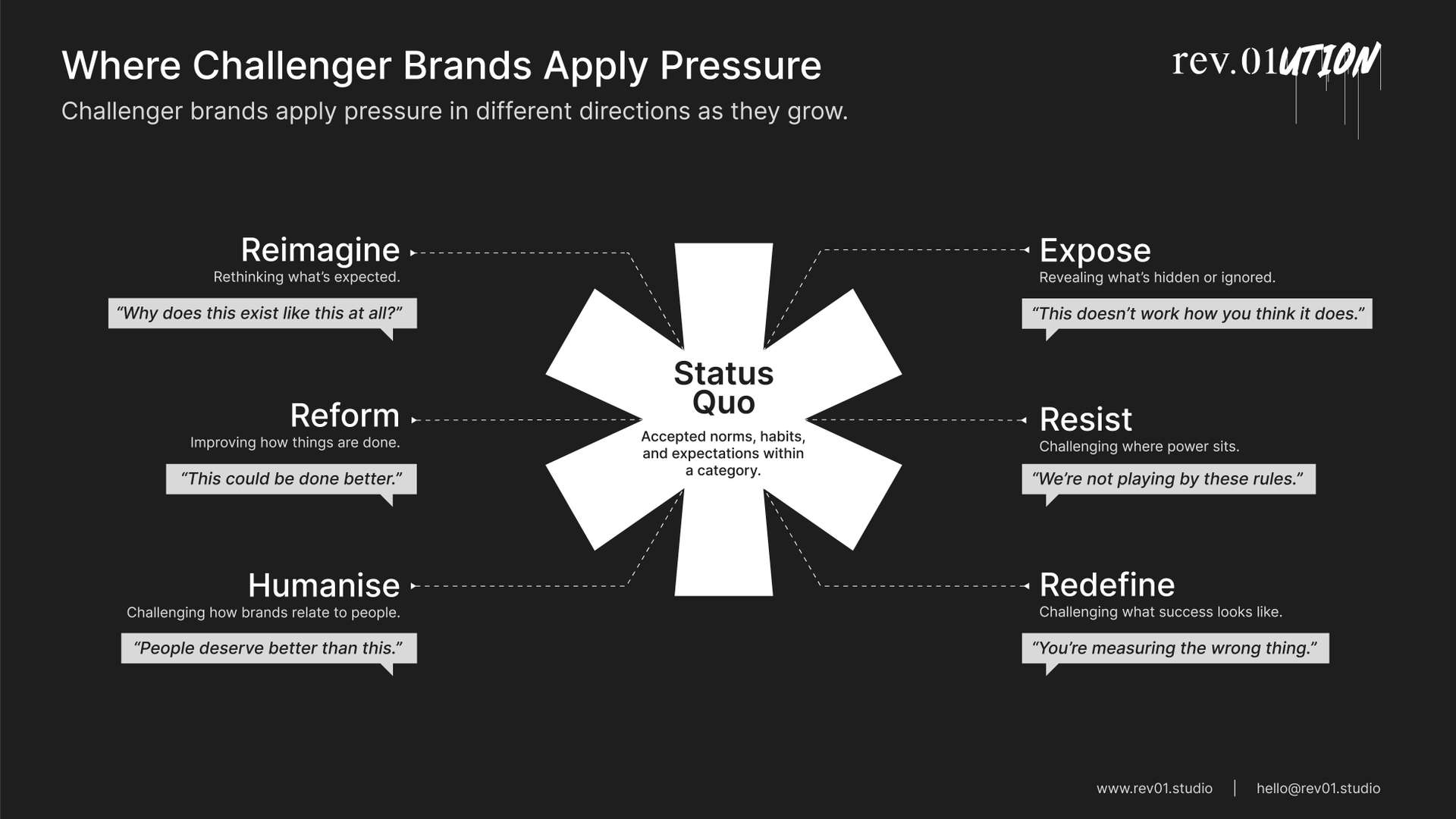
One of the reasons challenger brands are often misunderstood is that they’re treated as a single identity, when in reality they behave very differently depending on where they choose to apply pressure.
Not every challenger brand is trying to disrupt an industry outright. Some challenge how things are done. Others expose uncomfortable truths. Some reimagine experiences, while others push back against systems that no longer feel fair or relevant.
What matters isn’t the label a brand adopts, but where it applies pressure.
This way of thinking moves the conversation away from fixed “types” or archetypes and towards behaviour. It recognises that challenger brands evolve, and that the way a brand challenges early on may not be the same as how it challenges once it grows.
Understanding where that pressure is being applied gives clarity. It helps brands make decisions with more confidence, communicate with more intent, and grow without diluting what made them different in the first place. Without that clarity, challenger energy often turns into noise, well-intentioned, but unfocused.
This idea underpins much of how we think about challenger brands at rev.01, and it becomes especially powerful when translated into practical strategy
Most brands, regardless of ambition, make the same mistake early on. They jump straight to what the brand looks like.
The logo. The colours. How it appears on social media. It’s understandable. Visual identity feels tangible and exciting, especially for founders who see the brand as an extension of themselves.
But without foundations, everything built on top becomes noise.
For challenger brands, this is even more critical. They’re often asking people to see a problem they didn’t know existed or to rethink an established habit. If clarity isn’t there from the start, buy-in becomes incredibly difficult.
Brand strategy provides that clarity. It defines where the brand is going, what it believes in, what it challenges, and how it behaves. It gives good ideas the best possible chance to be understood at the right moment. Timing matters, but readiness matters more.
Skipping strategy doesn’t save time. It makes the rest of the journey harder.
Without clear foundations, the founder becomes the brand manual. Every new hire requires explanation. Every decision needs context. Standards live in someone’s head rather than within the business itself.
Over time, that becomes exhausting.
With a clear strategy in place, culture starts to carry the brand. New people absorb it naturally. Customers understand it more quickly and decide whether it aligns with their own values. Belief replaces persuasion.
Values stop being decorative statements and start acting as a compass. Decision-making becomes simpler because there’s something consistent to refer back to. The brand shows up the same way week after week, not because it’s rigid, but because it knows who it is.
If your team doesn’t believe in the brand, no one else will.
Remove brand strategy and most challenger brands immediately struggle with direction. Decision-making becomes scattergun. Messaging contradicts itself. Founders spend their time putting out fires instead of moving the business forward.
The real danger is that this damage often isn’t obvious straight away. Trust erodes quietly. Momentum slows. Confidence dips internally. By the time the issue is recognised, meaningful ground has already been lost.
Belief is usually the first thing to go. Without it, even the strongest idea struggles to survive.
Most challenger brands aren’t started simply to make money. They’re started because someone cares enough about something to want to do it better. To challenge an industry that feels outdated or misaligned with modern values.
That intent matters. New generations respond to transparency, honesty, and humanity. Smaller brands that act with clarity and integrity often carry far more influence than their size would suggest.
You don’t need to be a global organisation to make a difference. Conviction and consistency go a long way.
One of the most common mistakes challenger brands make isn’t lack of ambition, it’s rushing.
Take a breath at the beginning. Slow the process down before making anything visible. Spend time understanding who the brand is, how it behaves, what it believes in, and where it draws the line.
Pressure-test those values in real situations. Let strategy inform identity, not the other way around. If the idea is genuinely strong, it deserves to be articulated properly.
That’s where brand strategy earns its place. Not as a document, but as a foundation. And for challenger brands, foundations are what allow good ideas to grow, influence, and last.
At rev.01, we work as a creative studio, not simply to make brands look better, but to help them think more clearly from the outset.
Our workshops are designed to slow the right things down early, so brands don’t have to keep stopping later. We focus on nailing the fundamentals that many challenger brands struggle to articulate when everything still lives in the founder’s head.
That usually means working through brand narrative, values, tone of voice, positioning, and the competitive landscape together, pressure-testing ideas until they hold up in the real world. Not as theory, but as practical tools teams can actually use.
For challenger brands, getting this right early isn’t about perfection. It’s about clarity. And clarity is what gives good ideas the room to grow.
Tag Name

2/03/2026
Thoughts from MAD//UpNorth 2026 on culture, belonging and why human creativity is doubling down in the ...
Tag Name

19/01/2026
Over the past few weeks, I’ve seen a growing conversation about the world going “back to analogue”. ...